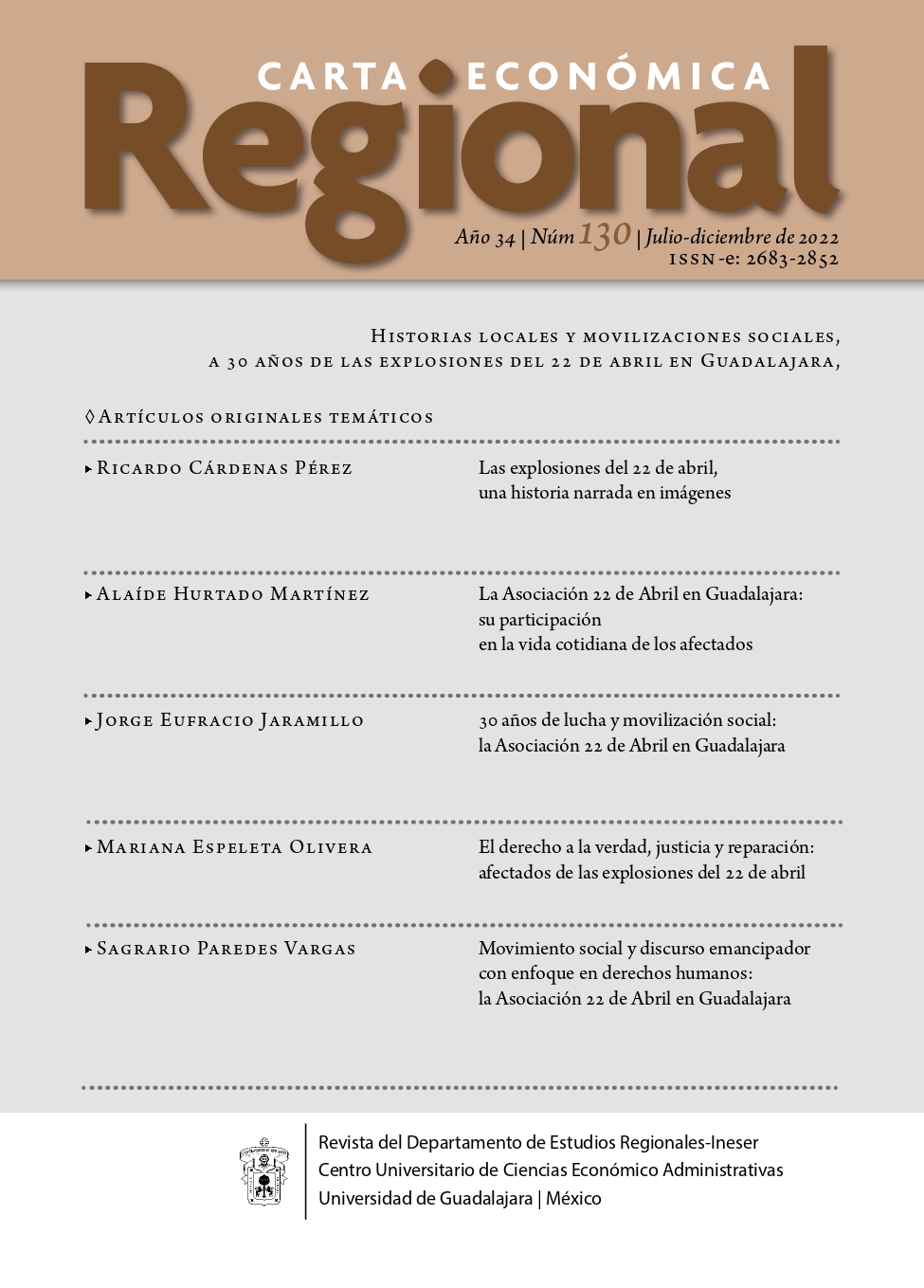
30 years of struggle and social mobilization: the Asociación 22 de Abril en Guadalajara
Abstract
This article will seek to explain the role that emotions play within an organized group of people injured by the explosions of April 22, 1992 in Guadalajara. Being disabled people, older adults and mostly women, this group has had to fight for the last 30 years to solve two fundamental problems: access to comprehensive health services and a life pension. However, the obstacles have been many. Moving away from conventional models to explain collective action, we wish to follow some of the theoretical tools provided by the sociology of emotions to understand the meaning of pain among these people, but seen not only from the bodily angle, but also from its social content. Likewise, how this debate can be taken to its moral dimensions as an explanatory factor of social mobilization.References
Bendelow, G. y Williams, S. (1995). Transcending the dualisms: toward a sociology of pain. Sociology of Health & Illness, 17 (2), 139-165. Doi: https://doi.org/10.1111/j.1467-9566.1995.tb00479.x
Chihu, Aquiles y López, Alejandro (2004). “El análisis de los marcos en la obra de William Gamson”, Estudios Sociológicos, Vol. XXII, No. 2, pp. 435-460.
Collins, R. (2001). Social movements and the focus of emotional attention. En J. Goodwin, J. Jasper y F. Polleta (eds.). Passionate Politics (pp. 27-44). Chicago, Estados Unidos: University of Chicago Press.
Eufracio, J. (2017). Testimonios sobre una herida abierta. Ecos y voces a 25 años de las explosiones del 22 de abril de 1992 en Guadalajara. Guadalajara, México: Miguel Ángel Porrúa y El Colegio de Jalisco.
Gamson, W. (1992). Talking politics. Nueva York, Estados Unidos: Cambridge University Press.
Honneth, A. (2009). Crítica del agravio moral. Patologías de la sociedad contemporánea. Buenos Aires, Argentina: FCE.
Jasper, J. (2013). Las emociones y los movimientos sociales: veinte años de teoría e investigación. Revista Latinoamericana de Estudios sobre Cuerpos, Emociones y Sociedad, 4 (10), 46-66. Recuperado de https://www.redalyc.org/articulo.oa?id=273224904005
Lalive, C. (2008). La vida cotidiana: construcción de un concepto sociológico y antropológico. Sociedad Hoy, (14), 9-31. Recuperado de https://www.redalyc.org/pdf/902/90215158002.pdf
Leder, Drew (1990). The absent body. Chicago, University of Chicago Press.
Leavitt, J. (1996). Meaning and Feeling in the Anthropology of Emotions. American Ethnologist, 23 (3) 514-539. Recuperado de https://www.researchgate.net/publication/227611920_Meaning_and_Feeling_in_the_Anthropology_of_Emotions
Moore, B. (1989). La injusticia: bases sociales de la obediencia y la rebelión. Ciudad de México, México: UNAM.
Poma, A. y Gravante, T. (2017). Emociones, protesta y acción colectiva: estado del arte y avances. Aposta, revista de ciencias sociales, (74), 32-62. Recuperado de http://www.redalyc.org/articulo.oa?id=495954961003
Sauerwald, G. (2008). Reconocimiento y liberación: Axel Honneth y el pensamiento latinoamericano. Berlín, Alemania: Lit Verlag.
Turner, Bryan (1992). Regulating Bodies. Essays in Medical Sociology. Londres y Nueva York, Routledge.
Those authors who have publications with this magazine accept the following terms:
- The authors will retain their copyright and register the journal with the right of the first publication of their work, possibly they will be subject to the Creative Commons Recognition License that allows third parties to share the work provided that its author is specified and his first publication is a magazine.
- The authors may adopt other non-exclusive license agreements for the distribution of the version of the published work (for example: deposit it in an institutional telematic archive or publish it in a monographic volume) provided that the initial publication in this journal is specified.
- Authors are allowed and recommended to disseminate their work through the Internet (e.g., in institutional telematic archives or on their website) after the work is publish, which can produce interesting exchanges and increase citations of the published work. (Watch The effect of open access).








 This work is licensed under a